
The Next Era of Qualitative Research: AI-Powered Insight Without Losing the Human Signal Copy
Artificial intelligence is changing qualitative research at a rapid pace. The promises are everywhere: faster turnaround, lower costs, instant summaries, automated reporting.
Some of that progress is real. But in qualitative research, speed alone does not deliver breakthrough insights.
The real opportunity is not using AI to replace researchers but rather to use AI to help researchers work faster, scale smarter, and extract deeper insights without losing the nuance, emotion, and context that make qualitative research an essential part of the strategic process. That is the balance aha has been building toward, publicly and internally: AI should help the human researcher, not become the endgame.
AI can accelerate analysis, but it cannot replace human judgment
Qualitative research has always generated rich, complex, unstructured data: transcripts, open-ended responses, video, journals, ethnographic uploads, and live conversations. That richness is what makes qual valuable, but it is also what makes analysis time-intensive.
AI has an important role to play here.
Used appropriately, it can help teams move through large volumes of data efficiently, surface meaningful themes more quickly, and identify patterns that would have taken far longer to uncover manually. It can reduce the operational burden of analysis and give researchers more opportunity to focus on what matters most: interpretation, context, and strategic thinking.
But qualitative research is not just a sorting exercise. It is not simply about identifying recurring words or generating polished summaries. The value comes from knowing what matters, what is contradictory, what feels performative, what reveals tension, and what points to something deeper below the surface.
That level of understanding requires human judgment.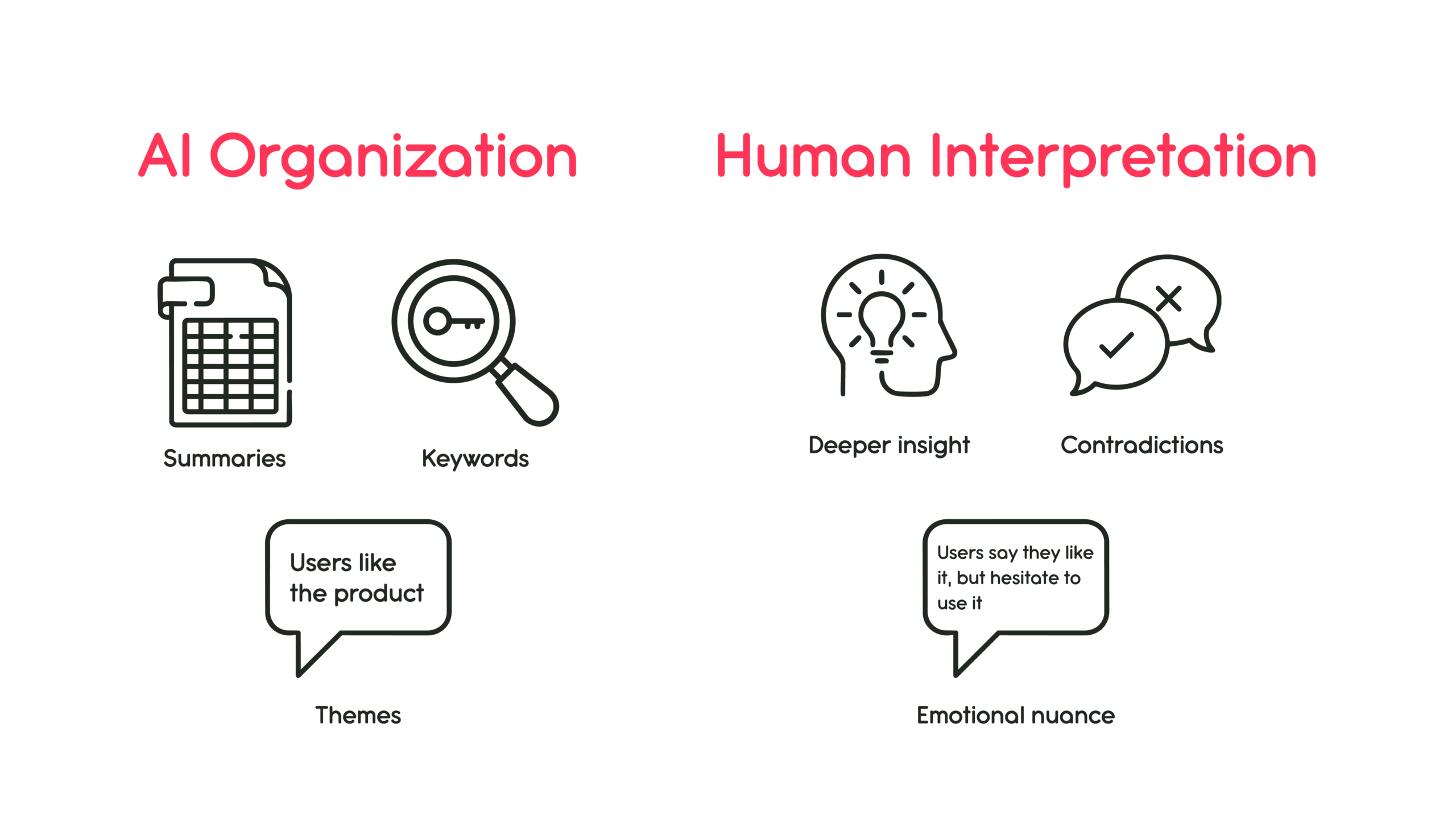
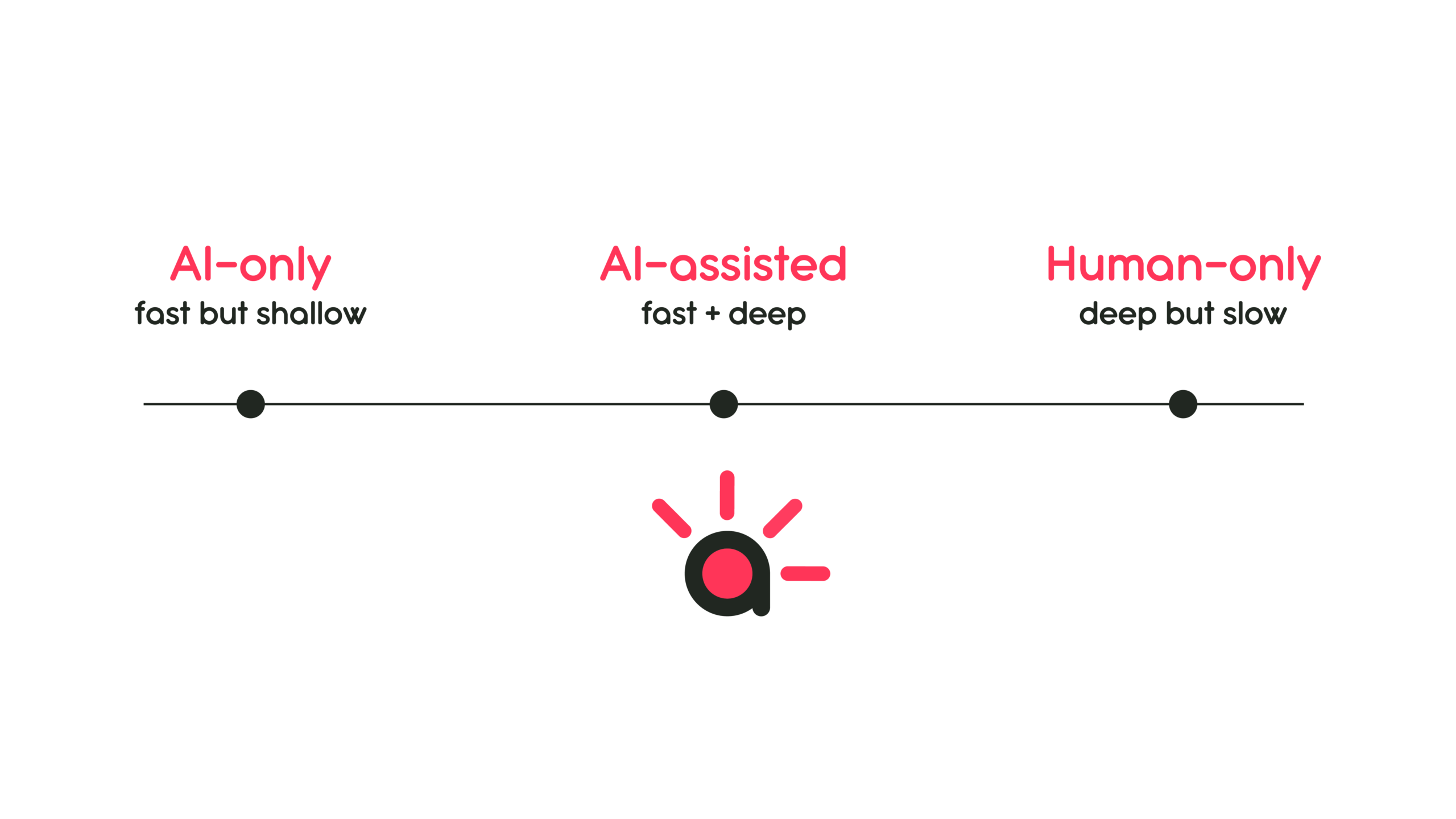
The future of qual is AI-assisted, not AI-only
As AI becomes more prominent across the research space, there is growing pressure to automate more of the process. In some corners of the industry, that pressure has turned into a race toward replacement.
That is the wrong goal.
The strongest qualitative research still depends on human expertise at every stage: choosing the right methodology, designing the right activities, reading emotional nuance, recognizing contradiction, and translating findings into decisions that businesses can actually act on.
AI can strengthen that process. It can make it faster, more efficient, and scalable. But it should support the work, not substitute for the skilled thinking behind it.
The role of AI in qualitative research is not to eliminate the human signal. It is to help teams get to it faster and with great clarity. Preserving what makes qualitative research even more valuable
What makes qualitative research powerful is not just what people say. It is how they say it, what they hesitate on, what they contradict, what they reveal indirectly, and what their behavior communicates in context.
That is especially true in digital ethnography, where the goal is not to force people into artificial environments, but to understand them more authentically in the flow of real life.
When AI is applied thoughtfully, it helps researchers manage scale without flattening that complexity. It helps organize the mess without stripping out the meaning. It helps surface patterns while still leaving room for the researcher to interpret what those patterns actually mean.
That balance matters.
Because not everything that looks like noise is disposable. In qualitative work, what first appears messy is often where the real insight lives.
Better technology should make research more human, not less
The most useful AI in research is not disconnected, bolted on, or used as a shortcut at the very end. It works best when it is part of a broader research ecosystem, one that supports better study design, smoother fieldwork, faster synthesis, and clearer reporting in one connected flow.
That kind of integration matters because it protects context. It reduces friction. And it allows insight teams to move from collection to analysis to output more seamlessly, without losing the thread along the way.
The goal is not automation for its own sake. The goal is to create a research process that is more agile, scalable, and responsive to the pace of modern decision-making, while still grounded in authentic human understanding of the psychological layers of consumer behavior.
The next era of qualitative research needs to get the balance right.
The next phase of qualitative research will not belong to those trying hardest to remove people from the process. It will belong to the teams that know how to combine machine speed with human understanding.
That means using AI to reduce manual effort, accelerate analysis, and support stronger decision making, preserving the empathy, interpretation, and behavioral nuance that turn raw input into real insight.
That is the approach aha is taking with AI today. Rather than treating AI as a replacement for the researcher, aha is using it to strengthen the research process itself – helping teams move through large volumes of qualitative data more efficiently, surface themes faster, quickly test theories, and generate clearer reporting without losing the context that makes the findings meaningful. Within aha’s broad ecosystem of live and asynchronous qual, digital ethnography, and flexible research support, AI plays a practical role: removing friction, improving speed, and making high-quality insight more scalable while keeping human judgment at the center.

Scale Smarter Without Losing the Human Signal
The future of qualitative research is not about choosing between speed and depth. It is about having the right system to achieve both. aha’s subscription plans are built for teams that want more control over how they design, run, and scale research while using AI to reduce analysis time, surface key themes faster, and create stronger reporting grounded in real human insight.
With customizable DIY and full service options, flexible methods, and a platform designed around the realities of modern insights work, aha gives teams the power to move faster, stay agile, and run research their way.
Explore our subscription plans to fund the right fit for your organization.

Ray Fischer
Co-Founder and CEO at aha! Insights Technology
A seasoned leader in qualitative research and technology, Ray has spent over two decades advancing how brands uncover human insights. From pioneering early online qual platforms to leading Aha’s global growth, he has consistently pushed innovation across hybrid research, AI powered analysis, and scalable digital methodologies, always with a focus on strengthening human understanding, not replacing it.