
AI & The Need for Speed. What I Saw at Quirk’s Chicago and IIEX
After spending time at both Quirk’s Chicago and IIEX in Washington DC over the past 3 weeks, one thing is clear:
The insights industry is not debating whether AI will matter.
It already does and has for the past few years.
Across both events (which were excellent BTW), AI continued to dominate the conversation. New tools, AI moderating, synthetic data models, automated reporting, and DIY platforms are rapidly reshaping how research gets done. There is real momentum, massive investment, and lots of potential happening across the space.
But beneath that momentum, a more important shift is taking place:
The conversation is no longer about access to AI.
It is about how, why, and where it is being applied.
The market is moving fast. Maybe too fast?
One of the strongest signals coming out of both conferences is the need for speed.
Faster turnaround.
Faster insights.
Faster decisions.
That pressure is real. Clients are being asked to do more with smaller budgets and fewer people. Timelines are shrinking, and expectations are rising.
But with that, we are starting to see a dangerous pattern emerge.
Speed is being positioned as the primary value, not accuracy. “Good enough” is becoming “ok”. What?!?
And in some cases, it is coming at the expense of something far more important: confidence in the results.
Synthetic has a role. But it has limits.
There is no question that AI and synthetic research are gaining traction.
And to be clear, it has a place.
For early-stage ideation, quick directional reads, and exploring scenarios at scale, it can be incredibly useful.
But what stood out in multiple conversations at both events is that leaders are still cautious about where synthetic ends and real understanding begins.
In one example, a senior industry executive shared a case study with me at Quirk’s/Chicago: their company tested a synthetic solution against a previous human-led study they had conducted. The results diverged significantly, and the concept that had previously performed strongly with real respondents did not translate through the synthetic model, in fact the results were wildly different. Needless to say, this executive is not taking a synthetic risk with his client’s research projects at this time.
In another example, a speaker from a large quantitative company presented on synthetic respondents. He intimated that the synthetic applied to both Quant and Qual. He was asked a very basic question about how they were training the synthetic model to handle qual, and he admitted there were some shortcomings, and they were simply using closed-end survey data to do that training. Sounds very dangerous to me! I understand the application to quant, but to make that leap to qual makes no sense.
These examples are not an indictment of synthetic.
They are a reminder of its boundaries.
Because when decisions carry real business consequences, “directionally right” is not always good enough.
Now, of course, I must mention a positive conversation with a CPG CEO, who clearly intimated that synthetic doesn’t apply to everything, but it certainly helps in expeditiously generating new product ideas and simulating potential performance in the marketplace. He also emphasized that human validation remains a critical part of that process. Right now, he feels it is safe for early-stage thinking and directional exploration. It is sort of like a human using ChatGPT, it is helpful and directional, but you can’t necessarily rely on it to make significant real-life decisions.
The real challenge is not speed. It is trust.
The industry does not have a speed problem – it has a trust problem. Particularly with data quality, primarily on the quant sample side.
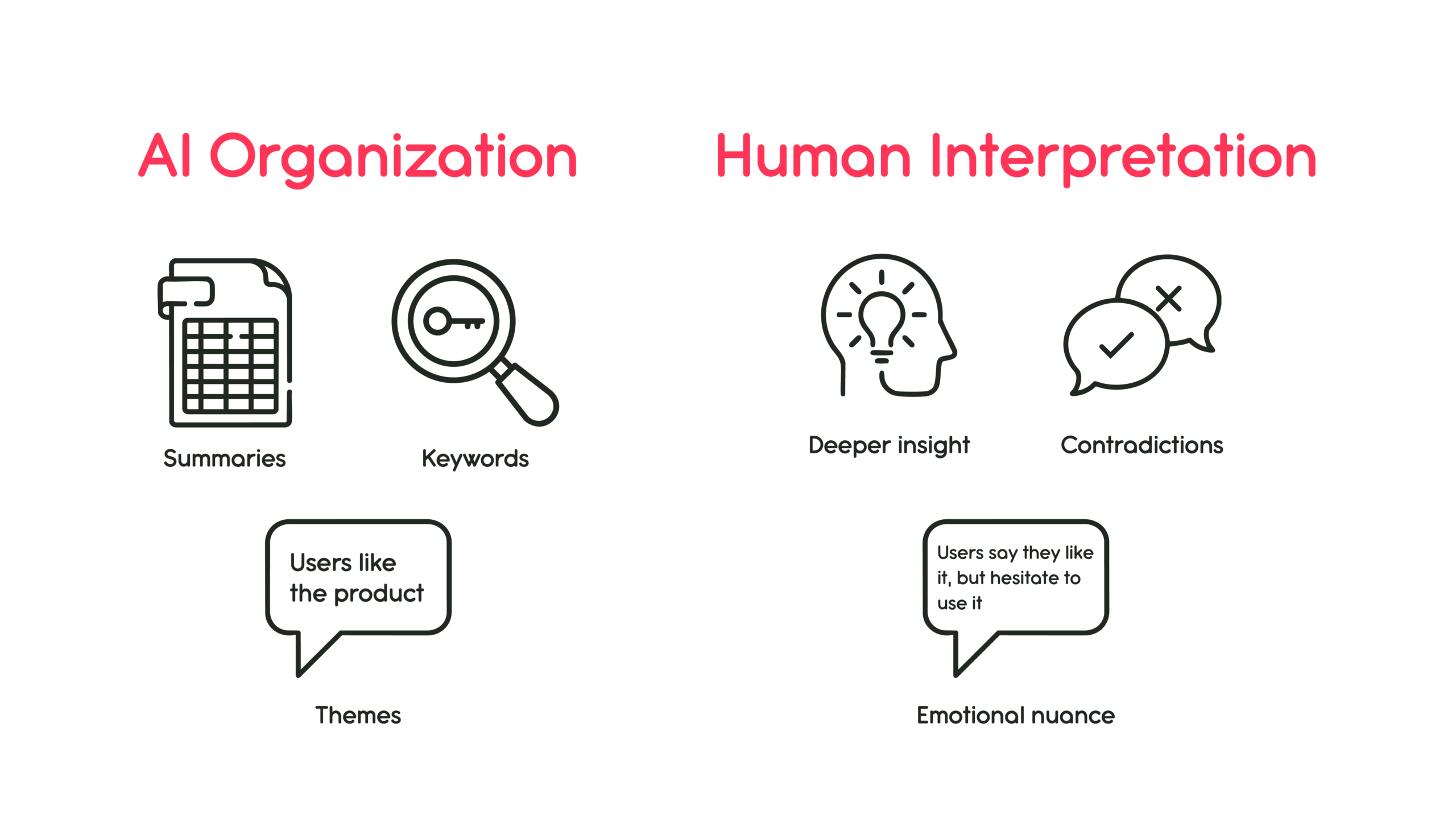
AI can generate outputs, summarize, cluster, and synthesize data faster than ever before.
But it does not guarantee that what you are looking at is grounded in real human behavior, real emotion, or real context.
And that is where things start to break down.
Because insights are not just about what people say.
They are about how they feel, why they behave the way they do, and what it actually means for product development.
That layer does not come from automation alone.

A Better Model: Two ways to move fast without losing the human signal
What I kept coming back to after both events is this:
The future is not about choosing between speed and quality, but about designing research differently.
There are two practical ways that we at aha address this:
1. Quick-turn research with real people
If speed and depth are the priority, the answer is not synthetic-only outputs.
It does cry for faster access to real humans.
That means:
- Rapid, targeted recruiting
- Live conversations and/or structured exercises
- Capturing real reactions, language, and uncovering emotional layers
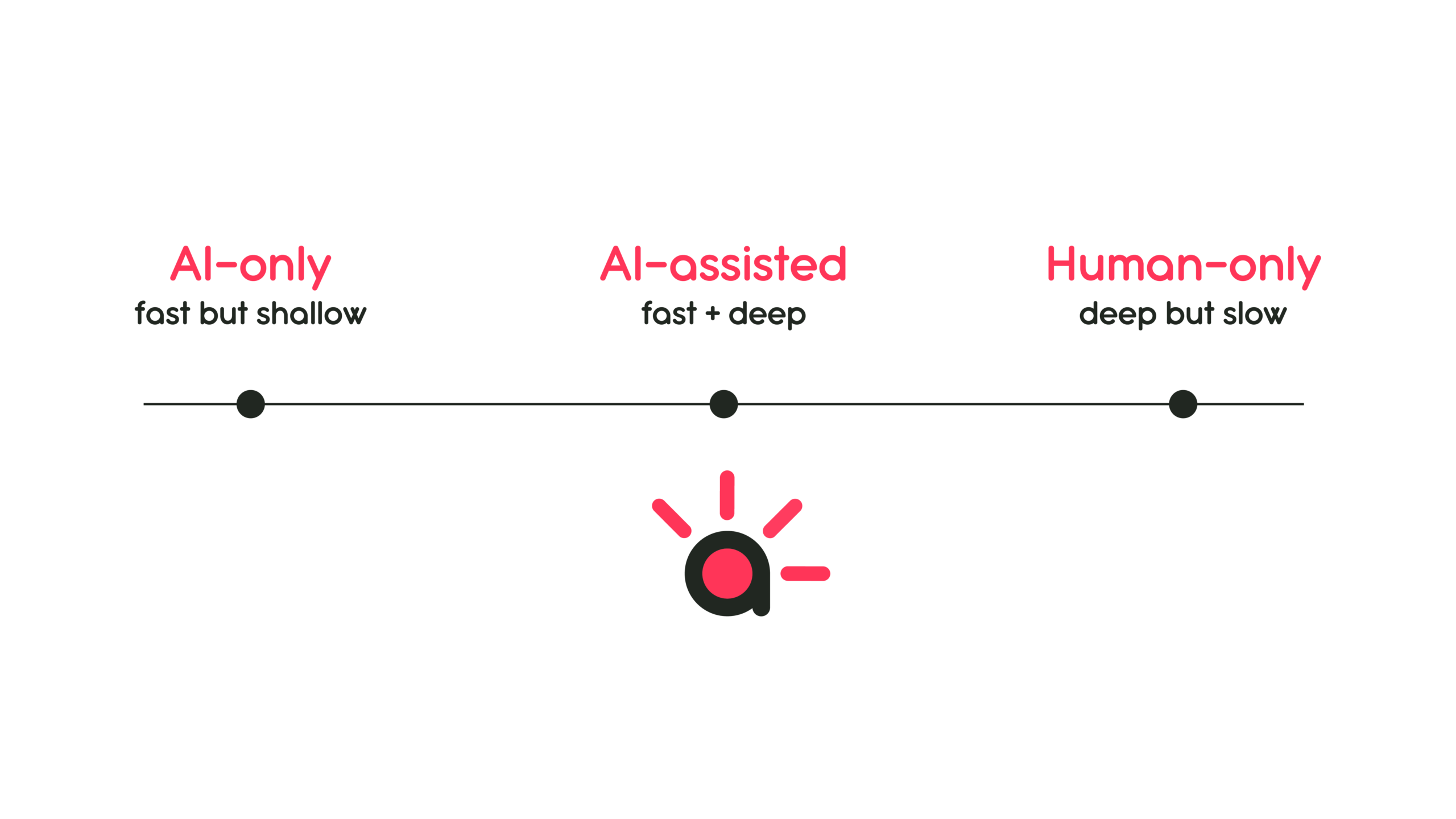
- Using AI to accelerate analysis once the data is collected, with Human researchers being the final judgment layer
This gives you something synthetic cannot fully replicate:
Real human response, delivered at speed, with AI-assistance.
You still move quickly, aiming for answers in 24-48 hours.
And you are not guessing…or hoping the synthetic model is near perfect (they are not all the same).
2. Always-on communities
The second model is even more powerful over time.
Instead of starting from zero every time you need answers, you build ongoing access to your customer audience.
Always-on communities allow you to:
- Return to the same respondents with some cadence and ongoing engagement
- Test, iterate, and validate ideas continuously
- Move from one-off studies to continuous learning
- Use multiple qualitative methods depending on the objective of the learning
Speed here does not come from cutting corners.
It comes from having the infrastructure already in place and tapping it as needed.
This is what enables foresight
What these two approaches ultimately change is not just speed.
They change what the insights teams can deliver.
When you can access real people quickly, or return to an always-on audience, research stops being a one-off exercise – it becomes continuous.
Instead of asking, “What happened?”.
You can start asking, “What is happening right now?”, “What is starting to shift?”, and “What should we do next?”.
That is the shift toward foresight.
It is not driven solely by AI.
It is enabled by having a consistent, reliable connection to real human input, combined with the ability to process and interpret that input quickly with human researcher oversight.
AI plays a critical role here. It helps surface patterns faster, connect signals across studies, and reduce the time between question and answer.
But foresight only works if the foundation is sound.
If the inputs are flawed, the outputs will be too.
Which is why the human layer does not go away – it becomes even more important.
My Final Takeaway
AI is redefining what is possible in research.
It is making speed a priority and a reality.
But speed alone creates a new problem:
When everyone can generate outputs quickly, the differentiator is no longer speed.
It is confidence in your results.
Confidence in the data, interpretation, and decision.
And that only comes from keeping the human element where it matters most.
Reach out to me if you would like to talk about these opinions and dive deeper into what aha has to offer to deliver AI speed with Human experience.

Ray Fischer
Co-Founder and CEO at aha! Insights Technology
A seasoned leader in qualitative research and technology, Ray has spent over two decades advancing how brands uncover human insights. From pioneering early online qual platforms to leading Aha’s global growth, he has consistently pushed innovation across hybrid research, AI powered analysis, and scalable digital methodologies, always with a focus on strengthening human understanding, not replacing it.